Vocal Clone AI Review & Analysis: AI-Based Voice Cloning System for Content Creation and Marketing Use Cases
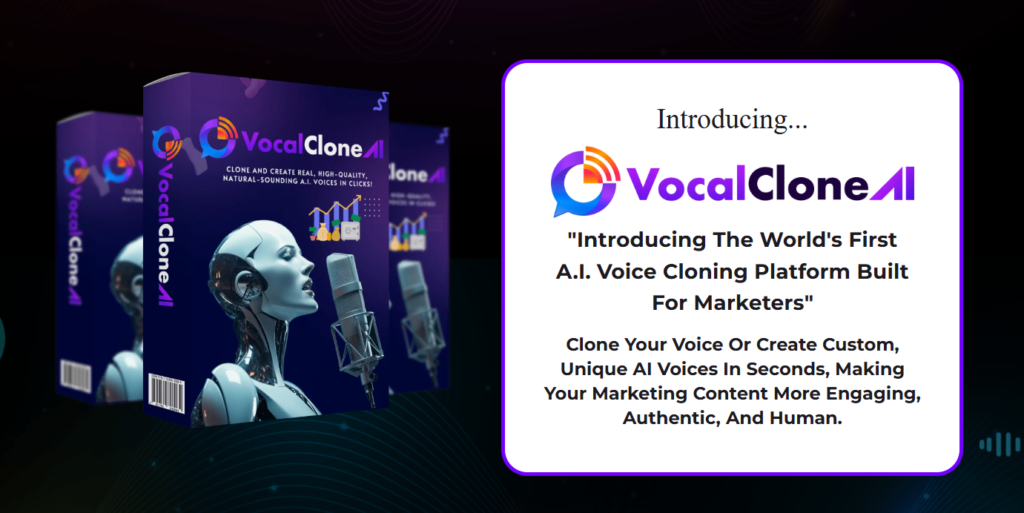
Vocal Clone AI is presented as a system designed to replicate human-like voices using artificial intelligence, with applications in content creation, marketing assets, and audio-based communication workflows. It appears targeted toward marketers, affiliate users, and creators exploring voice-driven content formats.
Can this improve audio content production efficiency?
The current content landscape is heavily influenced by AI-driven creation tools. While generating text, images, and videos has become faster, distribution and format diversification remain key challenges. Many users create content but struggle to adapt it into multiple formats—especially audio.
Vocal Clone AI is positioned as a structured system that focuses on voice replication and audio output generation, potentially enabling users to convert written or scripted content into voice-based formats. Rather than acting as a general marketing tool, it appears to operate within a specific workflow centered around AI-generated voice assets.
“This article contains affiliate links. If you click on a link and make a purchase, we may earn a small commission at no additional cost to you. We only recommend products that we believe may provide value to our readers.”
Table of Contents
- Converting Static Content into Scalable Audio Formats
- Why This Problem Matters: Content Format Expansion and Workflow Efficiency
- Manual Approach (Without Product)
- Where Vocal Clone AI Fits
- Core Mechanism
- How Vocal Clone AI Works (Daily Workflow Perspective)
- Key Features of Vocal Clone AI
- Genuine Pros and Cons
- What Makes Vocal Clone AI Different
- Helpful Tips
- Frequently Asked Questions
- Bonuses Included With Vocal Clone AI
- Final Verdict
Converting Static Content into Scalable Audio Formats
One challenge highlighted in AI-driven workflows is the lack of efficient systems for converting written or scripted content into voice-based assets. While text generation tools are widely available, transforming that content into natural-sounding audio often requires manual recording, editing, or outsourcing.
Based on the available product material, Vocal Clone AI appears to address this gap by enabling users to replicate voice outputs using AI, reducing dependency on manual recording processes. However, the exact depth of customization, voice training process, and output flexibility are not clearly specified in the available product material.
Content Format Expansion and Workflow Efficiency
Expanding content into multiple formats—especially audio—can influence how users distribute and reuse material across platforms. Without a structured approach, this process may become time-consuming and inconsistent.
A system like Vocal Clone AI is designed to potentially streamline this process by allowing users to generate voice outputs without repeated recording. This may help improve workflow efficiency and scalability, particularly for users working across multiple content channels.
However, the extent to which this system integrates with broader distribution strategies is not clearly detailed in the product material.
Manual Approach (Without Product)
Without a system like Vocal Clone AI, users typically rely on manual methods to create voice content. This often involves recording audio, editing files, and managing multiple takes to achieve acceptable quality.
This approach can be inconsistent and resource-intensive, especially for users producing content regularly.
Common limitations include:
- Repeated recording for each piece of content
- Variability in voice quality and tone
- Time spent on editing and post-production
- Limited scalability for large content volumes
Where Vocal Clone AI Fits
Vocal Clone AI appears to fit as a structured tool within the content production workflow, specifically focused on transforming scripts or text into AI-generated voice outputs.
Rather than acting as a complete marketing system, it seems to function as a component that supports audio content creation, which may then be used across different platforms.
Positioning highlights:
- Focus on voice generation, not full content distribution
- Designed to reduce manual recording effort
- May support repeatable audio production workflows
- Integration with broader strategies is not clearly specified
Curious How Vocal Clone AI Generates Voice Content?
If you want to understand how AI-based voice cloning works in practice, exploring the official page may provide additional context about its workflow and capabilities.
Button Text: View Official Overview
Core Mechanism of Vocal Clone AI
Input Voice or Script
Users provide input, which may include recorded voice samples or text/scripts.
(Exact input formats are not clearly specified in the product material.)
AI Voice Cloning Process
The system processes the input using AI to generate a replicated voice output.
(Details about training duration, accuracy, or customization are not clearly specified.)
Generate and Use Audio Output
The output is produced as an audio file that users can apply to their content workflows.
(Specific formats, integrations, or distribution channels are not clearly detailed.)
How Vocal Clone AI Works (Daily Workflow Perspective)
From a practical standpoint, a user may interact with the system in a repeatable manner:
- Prepare script or content
- Input into the system
- Generate voice output
- Use audio in content assets (videos, ads, etc.)
This workflow suggests a repeat loop, where the same process can be applied across multiple pieces of content. However, automation depth and batching capabilities are not clearly specified.
Key Features of Vocal Clone AI
Features play a role in understanding how a system operates, but they must be grounded in what is explicitly stated.
Based on the available product material, Vocal Clone AI appears to include:
- Cloud-Based Access: The software operates entirely online without requiring installation, allowing access via browser with an internet connection.
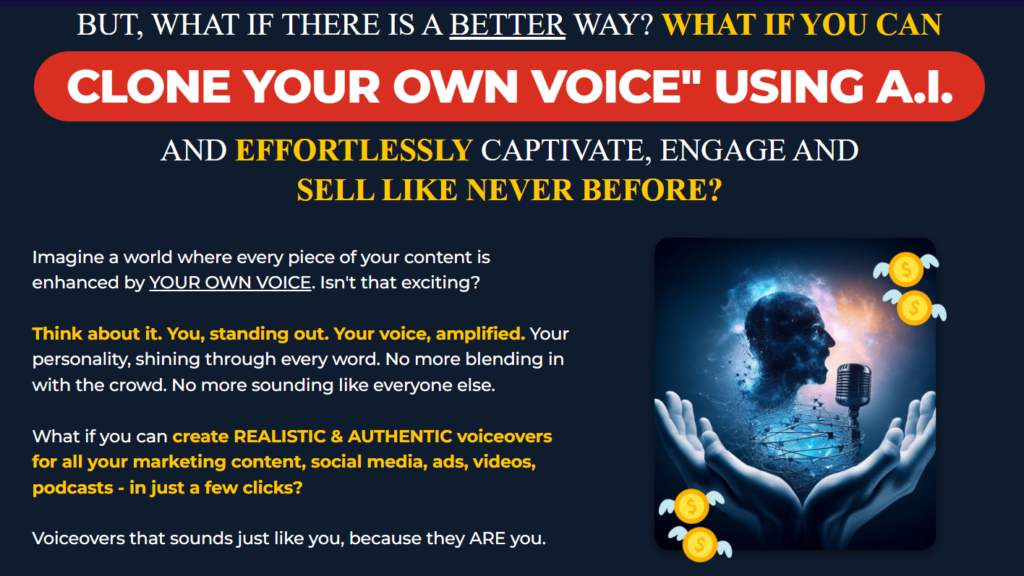
- Voice Cloning Functionality: Users can replicate their own voice or other voices for use in content such as videos, webinars, or audio materials.
- Emotion-Based Voice Output: The system includes voice variations designed to reflect different tones such as excitement or empathy.
- Text-to-Speech Conversion (Custom TTS): Converts written text into audio with adjustable parameters like pitch, speed, and voice type.
- Audio-to-Video Creation: Allows combining generated audio with visuals to create video-based content.
- VSL Script Generator: Provides script generation functionality for video-based content.
- Background Music Integration: Enables adding music layers to voice outputs for enhanced audio presentation.
- Audio Enhancement: Includes processing to improve clarity and quality of generated audio.
- AI Image Creation: Generates images for use in content materials.
- AI Video Creation: Assists in assembling video content using generated assets.
- Audio Merging Capability: Allows combining multiple audio clips into one file.
- Multilingual Voice Output: Supports voice generation in multiple languages (as listed on the product page).
Genuine Pros and Cons
Pros:
- Focused on a specific workflow (voice generation)
- May reduce need for manual recording
- Repeatable process for content production
Cons:
- Limited clarity on feature depth
- No detailed explanation of customization options
- Integration with other tools not specified
- Performance outcomes not demonstrated clearly
What Makes It Different
1. Voice Replication vs Manual Recording
Instead of recording audio manually, the system is designed to generate voice outputs through AI processing.
2. Script-Based Input Model
The workflow appears to begin with script or voice input, rather than requiring live recording each time.
3. Repeatable Audio Generation Loop
The system suggests a repeatable structure where users can generate multiple audio outputs from different inputs.
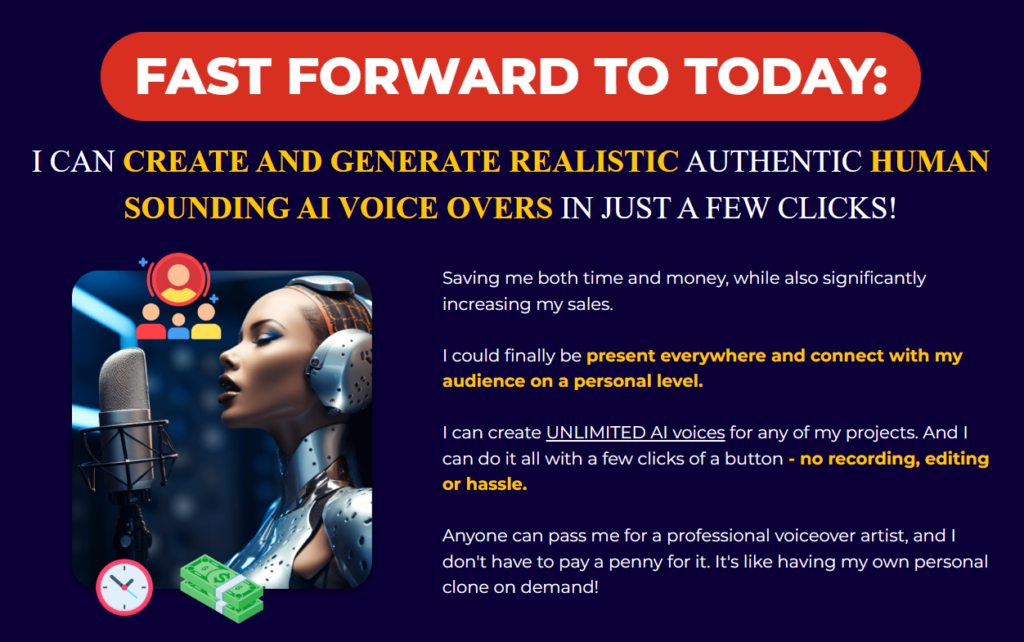
However, deeper differentiation such as proprietary models or unique routing systems is not clearly specified in the product material.
Can AI Voice Cloning Fit Your Workflow?
If you’re exploring ways to convert written content into audio formats, reviewing how Vocal Clone AI is structured may help determine if it aligns with your current process.
Helpful Tips
When using systems like Vocal Clone AI, expectations should remain aligned with the available information.
Consistency and testing may help users better understand how outputs behave across different inputs.
Suggestions:
- Test with different script styles
- Evaluate output quality across use cases
- Avoid relying on single-output assumptions
- Monitor how audio fits into broader workflows
Frequently Asked Questions
1. What does Vocal Clone AI do?
It is designed to generate voice outputs using AI, based on input such as scripts or voice samples.
2. Can it replace manual voice recording?
It may help reduce the need for manual recording, but effectiveness depends on use case and expectations.
3. Does it support multiple languages?
This is not clearly specified in the available product material.
4. Is it suitable for marketing content?
It can be used for audio-based marketing assets, depending on how users integrate the output.
5. Are results guaranteed?
No. Outcomes may vary depending on usage and implementation.
🎁 Bonuses Included With Vocal Clone AI
In addition to the core software, the product material mentions a set of included bonuses designed to support the overall workflow. These are presented as supplementary resources rather than core system components.


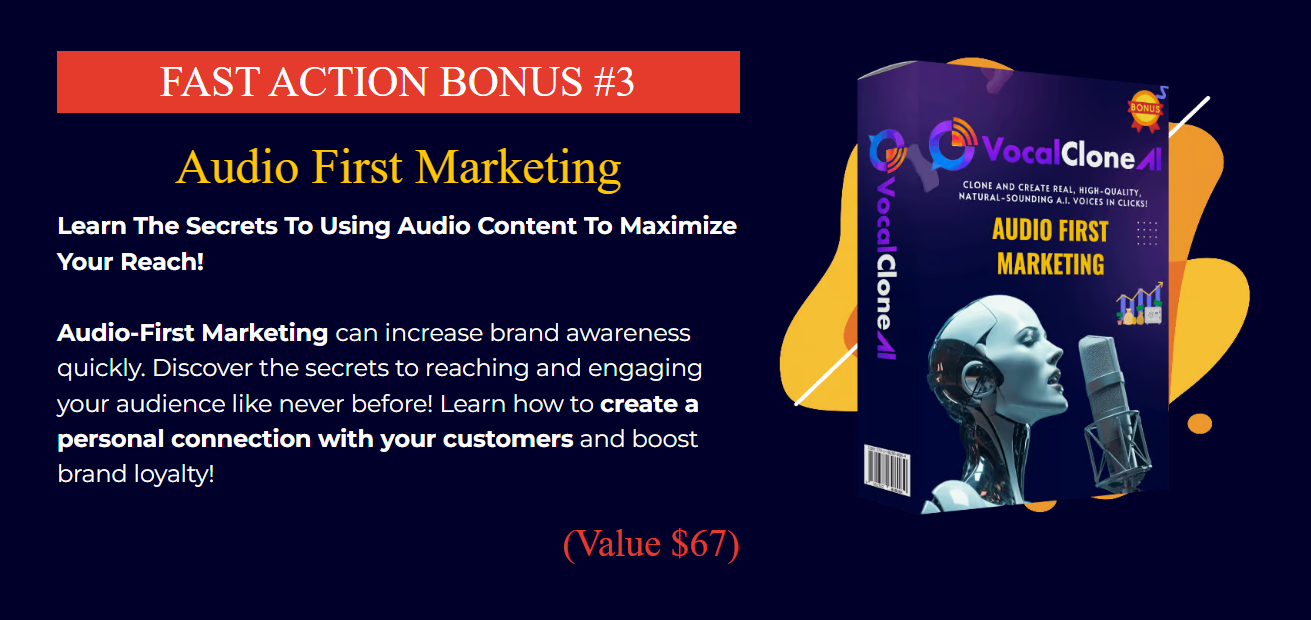
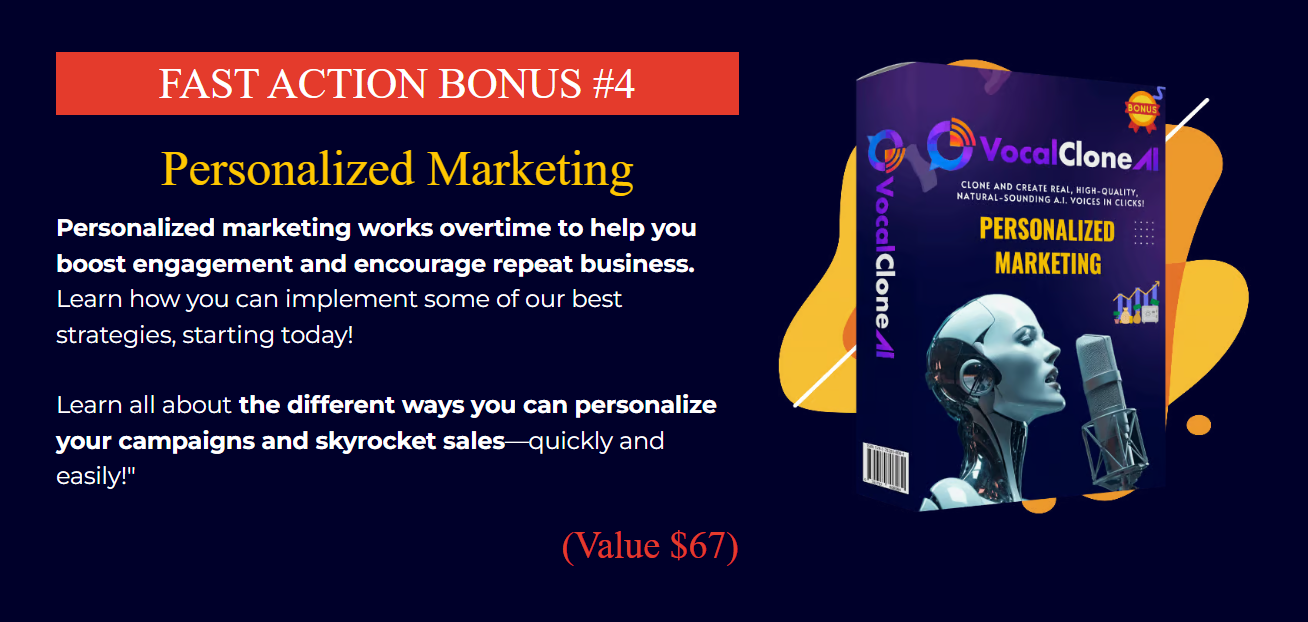
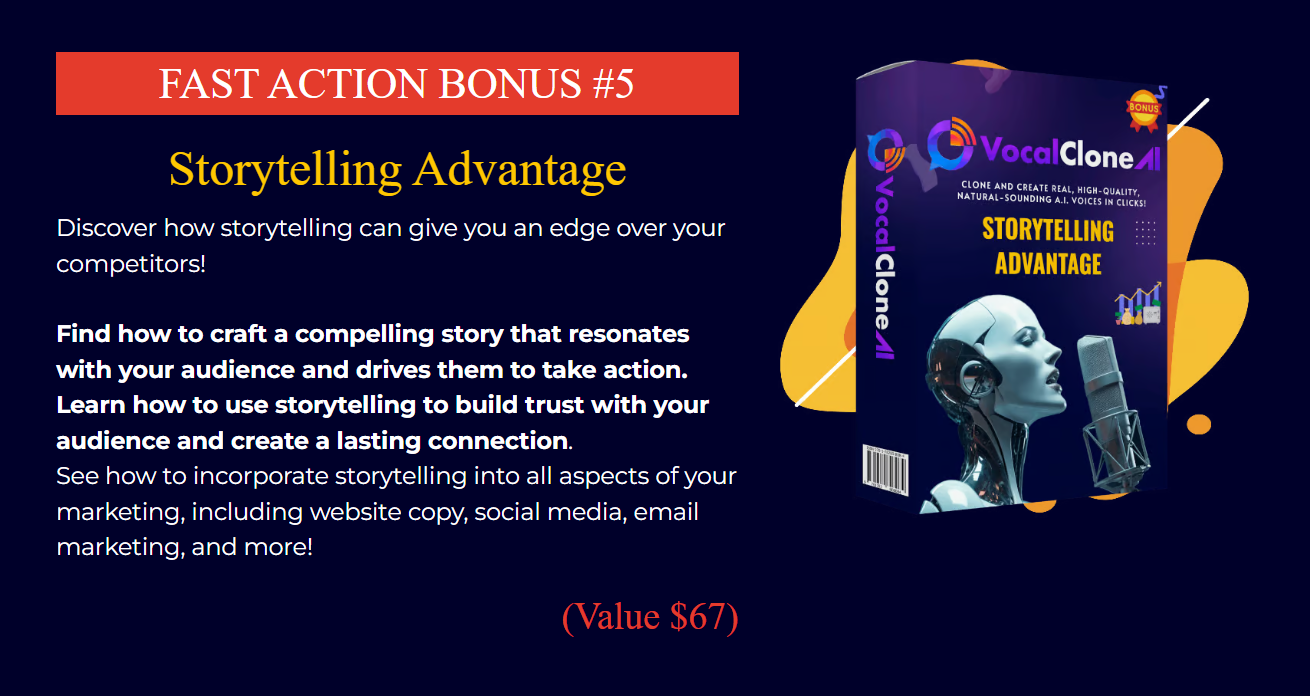

“The effectiveness of these bonuses is not independently verified in the product material. They are included as additional resources, and their impact may vary depending on how they are used.”
Final Verdict
Vocal Clone AI appears to be a specialized tool focused on AI-driven voice generation, positioned within the broader content creation workflow. It is not presented as a complete marketing system, but rather as a component that may support audio content production.
The system may be useful for users looking to experiment with voice-based formats, but several aspects—such as feature depth and integrations—are not fully detailed.
A cautious, exploratory approach is recommended.
“This article contains affiliate links. If you click on a link and make a purchase, we may earn a small commission at no additional cost to you. We only recommend products that we believe may provide value to our readers.”
Looking to review the full breakdown before making a decision?
If you’re considering Vocal Clone AI, reviewing the official page may help you better understand its features, structure, and potential use cases.
Important Disclaimer
This article is for informational and educational purposes only. Vocal Clone AI is a third-party product, and this review is based on publicly available product material. Affynza.com is not the creator or owner of the Vocal Clone AI product and does not provide customer support for it. For product support, account access, or technical assistance, please contact the official vendor.
Any images, testimonials, or bonus items shown are sourced from the official vendor and are used for illustrative purposes only. Product features, pricing, bonuses, and availability may change at any time at the vendor’s discretion.
This article is provided for informational purposes only. Marketplace selling activities involve various factors such as product selection, research, marketplace policies, and competition. Because of this, individual experiences may vary and specific outcomes cannot be guaranteed.